

How does rebranding impact your bottom line?
Take a look at the dollar value a great brand can contribute to your company now and when you sell.
REBRANDINGCASE STUDY
Chandra Blouin
8/15/20247 min read
If you're considering rebranding, you’re probably overwhelmed. I get it. Because you don’t know where to start. It seems like a massive undertaking. And because, hell, let’s just say it, it’s scary. You’ve had this brand for a long time. It’s on every truck, sign and brochure. It’s everywhere. What are customers going to think if you change it? Or your team?
Well, I’ll let you in on a little secret…if done right and for the right reasons, they’re all going to love it. It’ll get your customers talking and reenergize your entire team. They'll be pumped for the future knowing they’re part of a kickass team that’s ready to lead the industry and push your company, and profits, forward.
Okay, okay, that all sounds great...but how do I sell this to the finance guys you ask? How will rebranding impact my bottom line? Grab your cup of coffee or glass of wine and let's dig in.
How does brand add value to your business?
To understand how rebranding can help further drive the growth of your business, let’s first look at how brand adds value to your business on your Balance Sheet (something your finance guys will be very familiar with).
Brand value does not appear on your balance sheet while you operate the business.
It only shows up when your company is acquired.
At that point, accountants record Goodwill—the difference between the purchase price and the fair value of identifiable assets. That difference exists because the buyer believes the business will generate future earnings beyond what the physical and identifiable assets alone could produce.
Although this isn’t a physical asset, it reflects the premium investors and buyers are willing to pay for earning power beyond its tangible assets (see the McDonald's example below). That premium only becomes visible in financial statements during an acquisition.
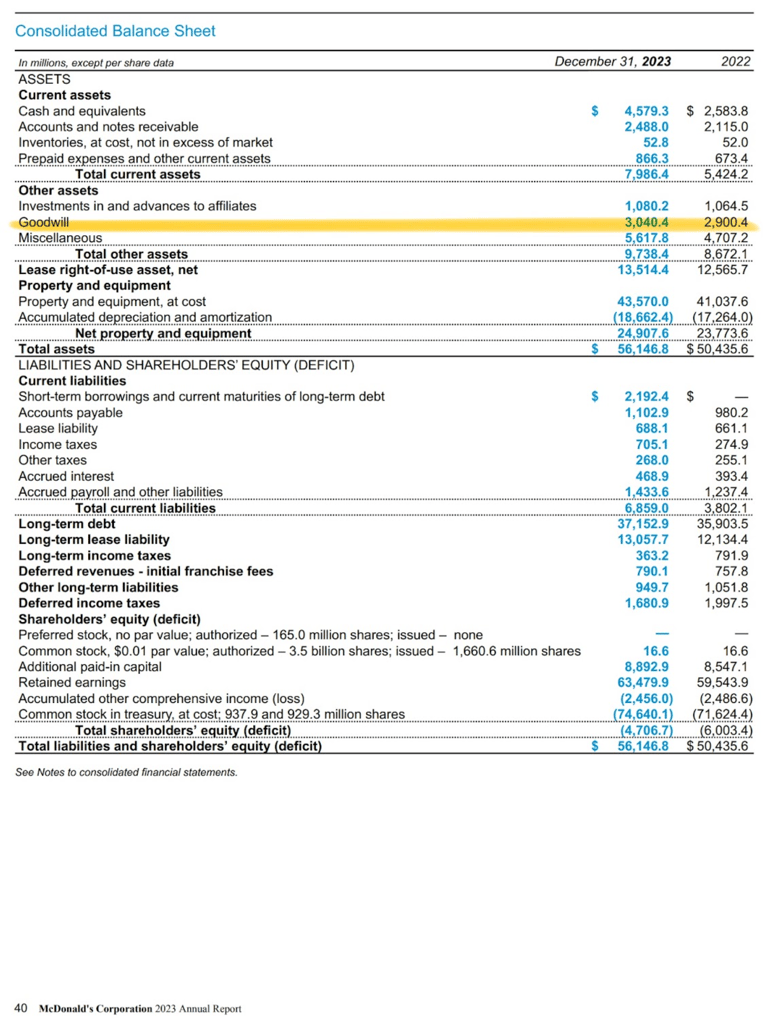
You're probably wondering what Goodwill has to do with brand, right? It's a great question and it comes down to how Goodwill is calculated. According to Investopedia Goodwill is "the portion of the purchase price that's higher than the sum of the net fair value of all of the assets" that comes from "the value of a company’s name, brand reputation, loyal customer base, solid customer service, good employee relations, and proprietary technology."
Brand is one of the primary drivers behind Goodwill.
A strong brand reduces risk, improves predictability of cash flows, strengthens customer retention, and supports pricing power. Buyers pay more for those conditions—and that premium becomes Goodwill in the purchase accounting. I won't get into how right now but I'll dive into that another day when we talk about creating aligned Brand Values for your company.
Now that we understand how important that brand is in the Goodwill of your business, let's look at what's involved in building brand.
How do you build brand?
These are the three key building blocks of brand.
Awareness
This is the initial exposure and your brand can enter someone’s awareness and it can happen through a combination of many avenues: another person, advertising, social media, signage, tradeshows and more.
Trust
Even before purchasing from you (or working for you), your brand looks and feels familiar to a person and the context and frequency in which your brand was seen or heard created feelings of comfort. This created enough trust that they will or would buy from you when the time is right.
Loyalty
Once someone has purchased from you or worked for you, the experience they had matched what they expected, or believed which makes them feel happy and they will buy again or tell others.
The bigger these building blocks get, the stronger your brand becomes, and the more your Goodwill grows. Think of Apple. Their awareness, trust and loyalty is so strong that people pre-order their latest product before it's even released. And it’s no surprise that, according to Brand Finance, Apple is the world’s most intangible-value-driven company, with $2.7 trillion in brand-related value in 2023.
This doesn’t mean Apple’s brand sits on its balance sheet at that number—it shows how much future earning power investors attribute to the business beyond its physical assets.
How does rebranding increase my business?
The purpose of rebranding is to position your company to build Awareness, Trust and Loyalty faster and cheaper, while maintaining the brand equity that you already have.
If, like many companies, you've been focused on growth and operations for many years, with little thought put into branding, there's a good chance that your brand is not optimized. That means you’re spending more than better-branded competitors while achieving less impact on enterprise value and buyer perception.
Let's look at how rebranding would add value in a very common business case.
A Case Study
You're a California based trucking company that started out in the business of transport up and down the I5 on the west coast. Over the years you've expanded your operations across the country, purchasing 5 more trucking companies so you can service the entire country. You're currently operating under 6 different brands. In this scenario we're going to assume that you've decided to move forward with a strategic rebrand that will unify all 6 brands under one cohesive brand.
Here are the cost savings and business increases you can expect with your rebrand:
Reduction in marketing costs
Rather than 6 marketing budgets to promote each brand, you'll have one marketing budget. It'll be more than one budget, but much less than all six combined. You'll no longer be creating and managing 6 sets of: brochures, business cards, stationery, signs, ad graphics, social media platforms, tradeshow booths, fleet graphics, memberships, and so on. You'll have one marketing budget, one marketing plan and one set of brand materials that you can more easily monitor for consistent use across your organization.Increase in reach and frequency, strengthening awareness and trust
Now that you have one brand out in the market, your audience will be exposed to your company much more frequently. They'll no longer see one logo at a tradeshow, another in an ad and yet another on a truck...never connecting the dots that all 3 companies are the same. This means that awareness of your company will increase quickly—and you'll achieve the 7 exposures needed to result in an audience behaviour change (i.e. remembering you, calling you, buying from you) up to 6x faster.Attract better staff, improving service quality and customer loyalty
People want to work for leading companies. It makes them feel proud. By building a great, strong brand you will instill pride in your current staff and also attract top talent throughout the industry. Retaining top talent will become much easier. And with top quality team members your customers will receive better quality products and service that will keep them coming back.Ability to increase prices
Stronger brands can charge a premium price. Period. Why else do you pay $5 for a Starbucks when you can buy coffee for $1 elsewhere? As the strength of your brand grows and customers begin to associate your brand with a consistent level of service and quality that they trust, you will have the luxury to charge a premium price.Decrease in confusion and increase in loyalty and word of mouth
With 6 brands in the marketplace you are experiencing the cost of confusion (whether you know it or not). This confusion is happening externally in the market as well as internally with your own people. Customers are buying from competitors because they didn't know you serviced that area or sold that product under another name. Your team is wasting time fretting about what esignature or business card to use, and how to introduce themselves when they meet someone new. And rather than one group of people on the same team, going the same direction, you have six teams competing against each other (it's human nature after all). Imagine having only one name. One team. One elevator pitch across the whole organization. How much simpler will it be to introduce your company at a tradeshow? To refer your company to others? To cross-sell your services and products to existing customers?Increase in goodwill and intangible assets
And back to that benefit that your finance guys are going to love the most. At the same time as all of the above sales and savings are being realized, you’re increasing the multiple a buyer is willing to pay for your business. When a transaction occurs, the premium created by brand clarity, cohesion, and reduced risk becomes Goodwill in the purchase accounting.
So when you combine all of the benefits of rebranding above it's very clear that optimizing your brand through the process of a strategic rebrand can make a big financial impact on your business.
One special note, however, before you jump all in and decide to consolidate all your brands into one. The example above is a very simplified scenario. There are always other considerations to take into account, including the brand equity you have already built in each of your existing brands. A strategic rebrand should always include an audit to assess each of your brands, and their individual equity, and then develop a strategy and process to transfer that equity to your new unified brand.
A quick note for finance leaders:
Brand value isn’t booked on the balance sheet during normal operations. It’s realized at exit. The stronger and clearer the brand, the lower the perceived risk—and the higher the price a buyer is willing to pay.
Creating a great brand, at any stage in your business, requires planning, foresight and strategy. And maintaining a great brand as your company grows requires ongoing brand management to ensure it is always consistent as well as strategic discussions and adjustments as your company evolves with acquisitions, mergers and ownership changes. If you have branding or rebranding questions, at any stage in your business, I'm here to help.